

Catherine Flon occupies a revered place in Haitian memory. According to the national tradition, she sewed together the revolutionary colors associated with the break from French colonial rule. Whether approached as documented biography, patriotic tradition, or symbolic history, her story illuminates how material acts—cutting, joining, and stitching cloth—can become part of a people’s political identity.
Ewo Ayiti Digital Museum · Hall of Heroes
Catherine Flon
Seamstress of a Nation’s Symbol
Remembered in Haitian national tradition as the woman who joined the revolutionary colors, Catherine Flon embodies the power of craftsmanship, unity, and women’s participation in the struggle for independence.
◷ Revolutionary era · 1803⌖ Saint-Domingue / Haiti
Curator’s introduction
A needle, a flag, and the making of national memory
Historical context
Symbols in a revolution against slavery and empire
Revolution and independence
The Haitian Revolution transformed the French colony of Saint-Domingue through a prolonged struggle against slavery, colonial domination, and attempts to restore the old order. Independence was proclaimed on January 1, 1804.
The flag tradition
Haitian national tradition links the creation of a revolutionary banner to Jean-Jacques Dessalines and Catherine Flon. The familiar account describes Flon sewing together colors after the white section of the French tricolor was removed.
Women’s participation
Women served the revolutionary movement in many capacities—as combatants, organizers, nurses, couriers, agricultural workers, caregivers, and keepers of community memory. Flon’s commemoration stands within this broader history.
Chronology
Catherine Flon in history and memory
Her early life is poorly documented; later tradition places her within revolutionary Saint-Domingue.
The uprising that developed into the Haitian Revolution begins.
National tradition associates Flon with sewing a revolutionary flag during the final struggle for independence.
Haiti proclaims independence on January 1.
Her image enters civic education, public commemoration, art, stamps, currency, and Flag Day memory.
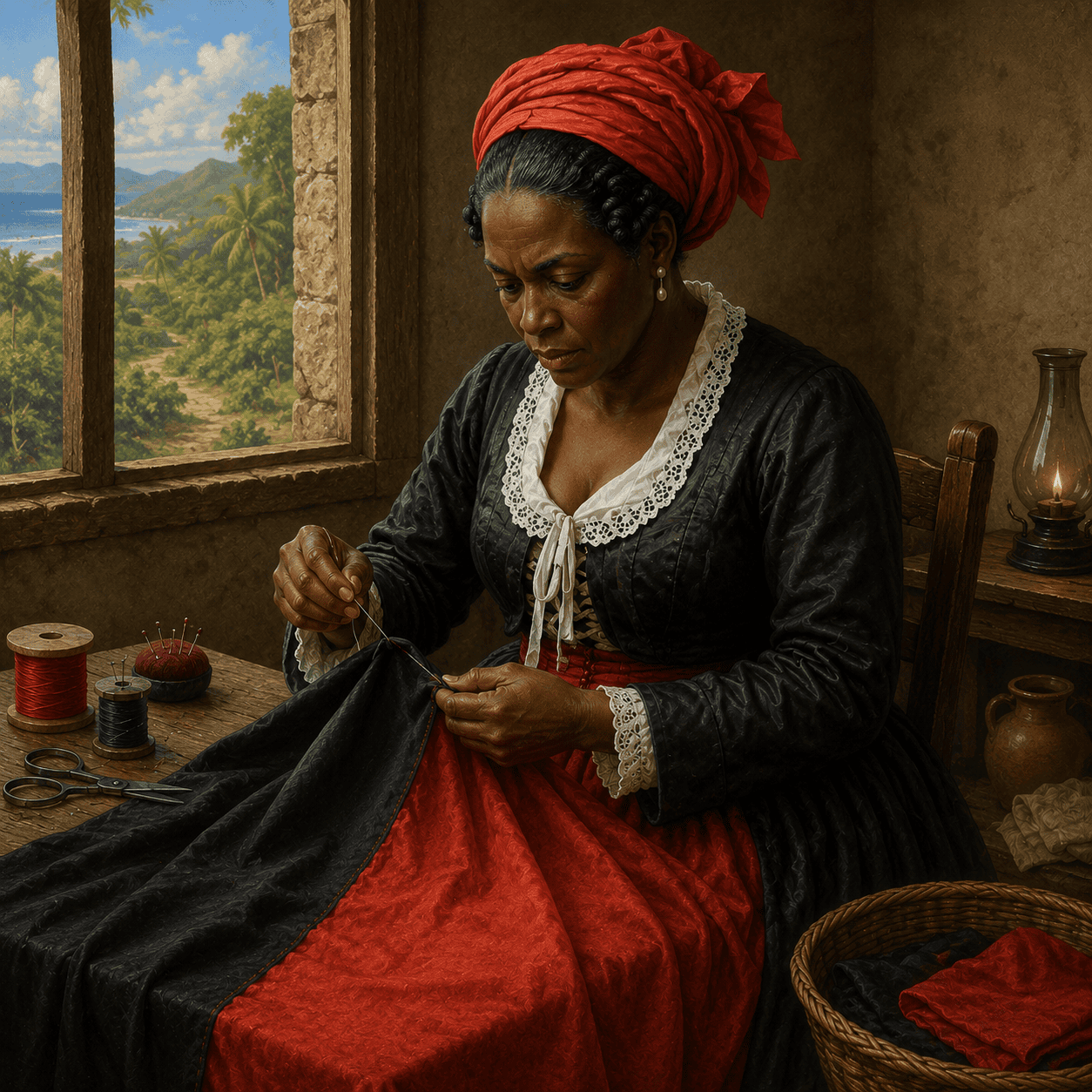
Featured visual interpretation
Catherine Flon sewing the revolutionary colors
This newly commissioned illustration presents Flon concentrating on the physical work of sewing. The needle, thread, fabric, lamp, and domestic workspace shift attention from spectacle to skilled labor. Her focused posture emphasizes deliberation, discipline, and purpose.
The black-and-red palette follows the Ewo Ayiti Digital Museum’s revolutionary visual language. It should be read as an interpretive museum artwork—not as a verified eyewitness reconstruction of the precise flag, room, clothing, or moment.
Curatorial note: the exact date, location, flag arrangement, and biographical details attached to the traditional narrative are not fully established by surviving contemporary records. The exhibit distinguishes national memory from archival certainty.
Evidence framework
What is documented, remembered, and interpreted
Primary evidence
Haiti’s revolutionary struggle and independence in 1804 are documented through contemporary proclamations, military records, correspondence, and later state documents.
Established public tradition
Official Haitian commemorations and long-standing national narratives consistently associate Catherine Flon with the sewing of the flag.
Plausible but debated
The precise circumstances—date, place, relationship to Dessalines, and details of the sewing episode—remain debated or weakly documented.
Legend and symbolism
Later artistic details, dialogue, clothing, room settings, and inspirational quotations belong to commemoration rather than verified biography.
Her legacy is not only the cloth she is remembered for joining, but the unity that generations of Haitians have seen in that act.Ewo Ayiti Digital Museum curatorial interpretation
Legacy
The enduring power of a national symbol
Catherine Flon’s public memory places a woman’s skilled labor at the center of national creation. Her story broadens the historical imagination beyond generals and battlefields and reminds visitors that revolutions also depend on communication, care, material knowledge, organization, and symbols capable of gathering people around a shared future.
Continue exploring
Related heroes
Further reading and source guidance
Selected references
- Embassy of Haiti, “Flag and Coat of Arms” and official Flag Day commemorations.
- N. L. Willson, “Unmaking the Tricolore: Catherine Flon, Material Memory and the Haitian Flag,” scholarly study of the flag narrative and its memorial history.
- Enslaved: Peoples of the Historical Slave Trade, Catherine Flon biographical entry.
- David Geggus, The Haitian Revolution: A Documentary History, for the broader documentary context of the Revolution.
- Carolyn Fick, The Making of Haiti, for the social and revolutionary history of Saint-Domingue.

