

Alexandre Sabès Pétion emerged from revolutionary Saint-Domingue as an artillery officer, military commander, constitutional leader, and president. His career cannot be reduced to a single heroic image. He fought colonial domination, yet also participated in factional struggles. As president, he promoted republican government and wider access to land while steadily concentrating executive power. His legacy belongs both to Haiti’s founding generation and to the unresolved tensions of post-revolutionary state-building.
Ewo Ayiti Digital Museum · Hall of Heroes
Alexandre Pétion
Revolutionary Commander · Republican President · Atlantic Liberator
Alexandre Pétion helped defeat French colonial rule, shaped the Republic of Haiti in the south and west, and extended Haiti’s revolutionary influence through material support for Simón Bolívar’s liberation campaign.
◷ 1770–1818⌖ Port-au-Prince · Republic of Haiti
Curator’s introduction
Revolutionary victory and the difficult work of governing freedom
Historical context
From colonial war to a divided independent Haiti
Revolutionary formation
Pétion’s career developed amid the conflicts after the 1791 uprising. He became associated with André Rigaud’s southern forces, fought in the War of the South, went into exile, returned with the Leclerc expedition, and later joined the anti-French struggle.
Independence and civil conflict
After independence and the assassination of Jean-Jacques Dessalines, political conflict divided the country. Henri Christophe controlled the north, while Pétion led a republic centered in the south and west.
A republic under pressure
Pétion’s government confronted military rivalry, weak revenues, contested authority, and the challenge of converting emancipation into durable institutions.
Chronology
Alexandre Pétion in revolution, government, and Atlantic history
Born in Port-au-Prince.
Fights with André Rigaud’s forces and later goes into exile.
Returns during the Leclerc expedition, then joins the anti-French struggle.
Elected president of the Republic of Haiti.
Receives Simón Bolívar and provides refuge, arms, supplies, and support.
A revised constitution establishes a presidency for life.
Dies in office; Jean-Pierre Boyer succeeds him.
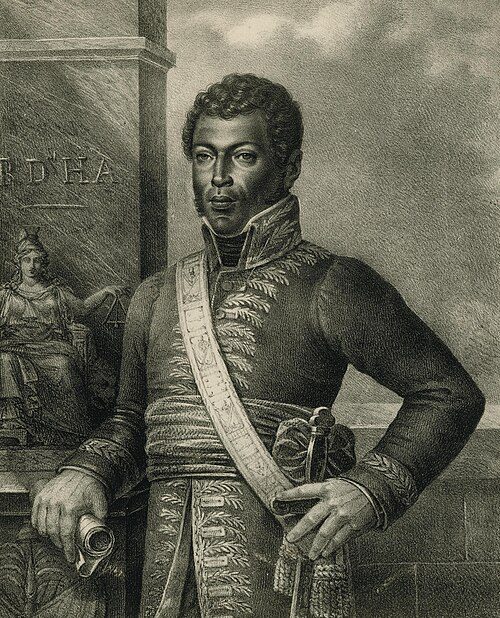
Portrait and public memory
The image of a republican founder
Formal portraits of Pétion emphasize military bearing, civic authority, and presidential dignity. Such imagery helped later generations construct a public memory of the republic’s founder and of a leader whose influence extended into Spanish American independence.
Curatorial note: Pétion has been praised for republicanism, land redistribution, and international solidarity, while criticized for factional politics, elite rule, weakening export production, and concentrating presidential power. The exhibit preserves these competing interpretations.
Leadership and policy
Achievements, contradictions, and consequences
Republican government
Constitutional institutions existed, but conflict with the Senate and later constitutional change increased presidential authority.
Land distribution
Large estates were divided and parcels distributed to soldiers, supporters, and cultivators. This expanded smallholding but weakened plantation-scale export production and state revenue.
Education and institutions
His administration supported civic institutions and educational initiatives associated with republican nation-building.
Conflict with Christophe
Pétion’s republic and Christophe’s northern state represented rival political systems and competing visions of labor, authority, and national unity.
Support for Bolívar
Pétion granted refuge and supplied Bolívar’s expedition with arms, ammunition, vessels, personnel, printing capacity, and political support, linked in historical accounts to an expectation of emancipation.
An Atlantic legacy
Haiti’s aid demonstrated that the country’s revolutionary mission could extend beyond national survival to wider anti-colonial struggles.
Evidence framework
What is documented, interpreted, and commemorated
Primary evidence
Pétion’s presidency, constitutional role, correspondence, and state actions are documented in official records and contemporary accounts.
Strong consensus
Historians broadly agree that Pétion materially supported Bolívar, redistributed land, and led the southern and western republic.
Interpretive debate
The effects of land policy, the inclusiveness of his republicanism, and the balance between constitutional rule and personal power remain debated.
Commemorative language
Idealized speeches, invented quotations, and claims that one leader alone “freed South America” belong to public memory rather than verified history.
Pétion’s legacy lies not in an uncomplicated model of leadership, but in the reach of Haiti’s revolutionary promise—from land and citizenship at home to liberation movements across the Americas.Ewo Ayiti Digital Museum curatorial interpretation
Legacy
A founder remembered across Haiti and the Americas
Pétion shaped republican institutions, patterns of landholding, relations between the state and cultivators, and Haiti’s place in Atlantic diplomacy. His assistance to Bolívar gave his reputation a continental dimension. His record also reveals the costs of political division and the danger of concentrating authority in the name of stability.
Continue exploring
Related heroes
Further reading
Selected references
- David Nicholls, From Dessalines to Duvalier.
- Laurent Dubois, Haiti: The Aftershocks of History.
- David Geggus, ed., The Haitian Revolution: A Documentary History.
- Beaubrun Ardouin, Études sur l’histoire d’Haïti.
- Dantès Bellegarde, writings on Alexandre Pétion and Haitian support for Spanish American independence.

